

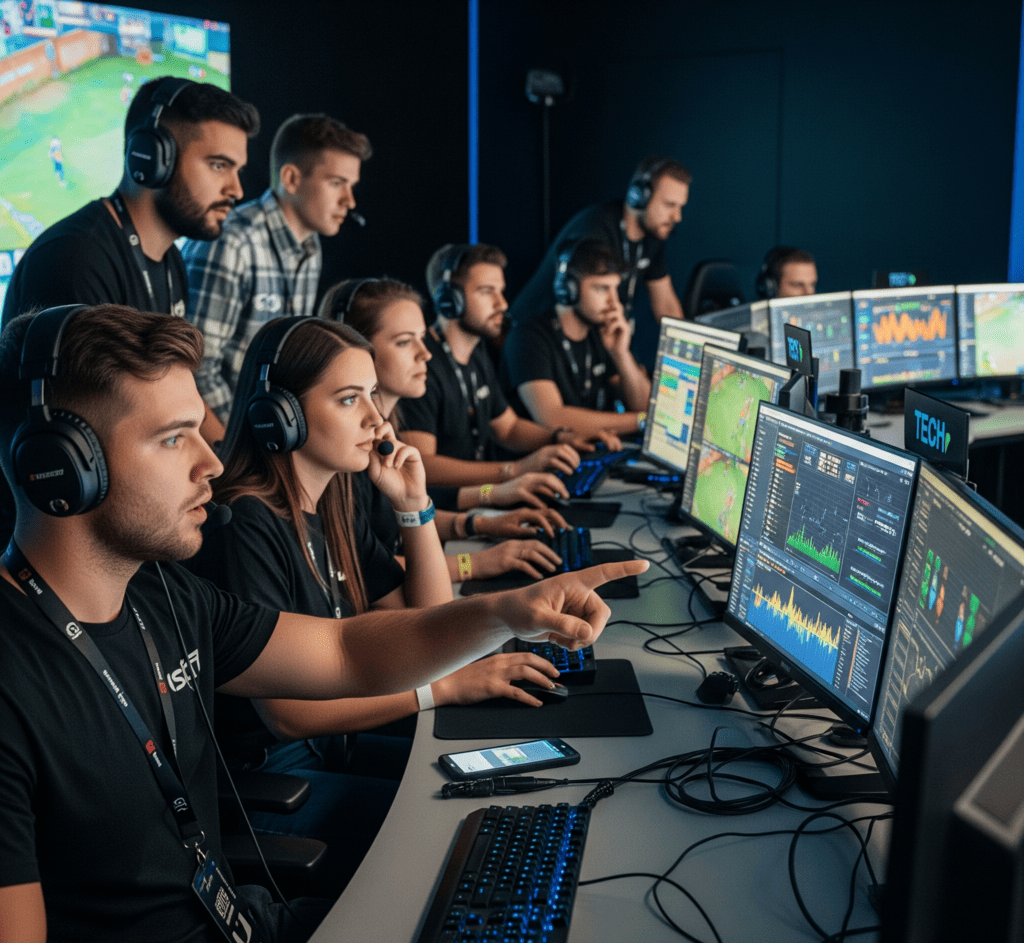
When the curtain rises and the LED lights turn on to make way for an epic battle between the best players in the world, the audience cheers, streamers shout, and influencers begin recording stories that will go viral. Everything seems spontaneous, perfect, fluid. But what no one sees —what actually makes that moment possible— is the logistics.
Logistics in a gaming event is not a support area. It is the operational core. It is the invisible foundation upon which the entire experience is built. And if it fails, everything collapses.
What does logistics involve in a video game event?
When we talk about logistics in this type of event, we are not just referring to moving consoles or setting up stages. We are talking about a millimetric orchestration that covers at least five major dimensions:
- Technological infrastructure
- Mobility and transportation
- Space management and assembly
- Food and participant care
- Coordination of talent and technical staff
Each of these areas is an operation in itself. And all of them must synchronize like the gears of a Swiss watch.
1. Infrastructure: the technical soul of the event
An esports competition cannot afford to have lag. There cannot be a dropped connection or a faulty monitor. Technical logistics includes:
- High-end computing equipment (and backups).
- Low-latency LAN network and independent public WiFi network.
- Redundant power systems (UPS + emergency plants).
- Professional audio for each zone: stage, play area, streaming, etc.
- Charging stations for mobile devices of players, staff, and influencers.
- On-site and remote technical support.
Everything must be tested, trialed, and approved at least 24 hours before the venue opens to the public.
2. Transportation: moving talent, equipment, and dreams
Behind every player, caster, or influencer, there is an itinerary. They arrive from different cities or countries. Some have tight schedules, others carry personal equipment. Many need special attention. Transportation logistics includes:
- Flight and lodging reservations.
- Airport reception and personalized transfer.
- Detailed itineraries with maps and schedules.
- Internal transportation logistics (shuttles, vans, coordinating staff).
- Delivery of credentials upon arrival.
And if something goes wrong —such as a flight cancellation— a contingency protocol is activated. The key is to anticipate the chaos.
3. Space assembly: that everything has a place… and a purpose
Every square meter of the venue counts. Poor arrangement can create bottlenecks, empty zones, or discomfort in the flow of people. Space logistics includes:
- Zoning: stage, free play zone, VIP zone, press zone, food area, entrance, emergency exits.
- Pedestrian flow: intuitive paths, quick access, clear signage.
- Security: checkpoint points, emergency protocols.
- Backstage: rest areas, dressing rooms, private catering.
A well-assembled gaming fair is one where the public moves fluidly… without asking where things are.
4. Food: eating well… to play better
If the event lasts more than 6 hours, food stops being a luxury and becomes a logistical necessity. One must consider:
- Catering for staff and special guests.
- Food trucks or food stations with sufficient variety.
- Special menus (vegan, gluten-free, lactose-free, etc.).
- Water available at key points.
- Waste and recycling (ecological management).
A gamer without energy is noticeable. And a hungry staff breaks down.
5. Staff, coordination, and immediate reaction
No event works without a well-trained operational team. This includes:
- Operating manuals for each area.
- Well-defined roles and shifts.
- Internal communication with radios or specialized apps.
- Emergency team: first aid, maintenance, technical support.
- Daily control meetings and real-time logs.
It is not enough to have people. You must have the right team in the right place at the exact moment.
What no one sees, but everyone feels
Logistics is not applauded. It is not seen in photos. It doesn’t gain likes. But it is felt. It is noticed when access is fast, when everything works, when the event is agile, clean, safe, and comfortable. Logistics is what transforms an average event into an unforgettable experience.
And the best part: when it’s done well, no one talks about it. Because nothing went wrong.
Conclusion
If you have ever attended a video game event that left you speechless, remember this: someone was behind it, tuning every detail as if it were a symphonic concert. That someone is the logistics team. It is the silent gear that makes everything flow and, without asking for applause, makes the magic happen.

 RECEIVE OUR NEWSLETTER